
Question 1What is tuberculosis?
Tuberculosis, commonly called TB, is an infectious disease caused mainly by the bacterium Mycobacterium tuberculosis. It most often affects the lungs, but it can also involve many other organs.
TB is preventable and usually curable when diagnosed early and treated correctly.
Question 2How does pulmonary tuberculosis spread?
Pulmonary TB spreads through the air. A person with infectious lung or throat TB can release bacteria while coughing, sneezing, speaking or singing.
How TB does spread
- Prolonged close contact indoors
- Repeated exposure in poorly ventilated spaces
- Household or workplace contact with an untreated case
How TB does not spread
- Shaking hands or casual touching
- Sharing food or utensils
- Brief passing contact
Question 3What are the common symptoms of lung TB?
Symptoms of pulmonary tuberculosis may include:
Anyone with a persistent cough, fever or unexplained weight loss should seek medical evaluation promptly. Delay allows the disease to progress and to spread to others.
Question 4What is extrapulmonary tuberculosis (EPTB)?
Extrapulmonary tuberculosis means TB affecting organs outside the lungs. It may involve the lymph nodes, pleura, bones, joints, spine, abdomen, brain coverings, urinary system, skin or other organs. Some patients have pulmonary and extrapulmonary TB together.
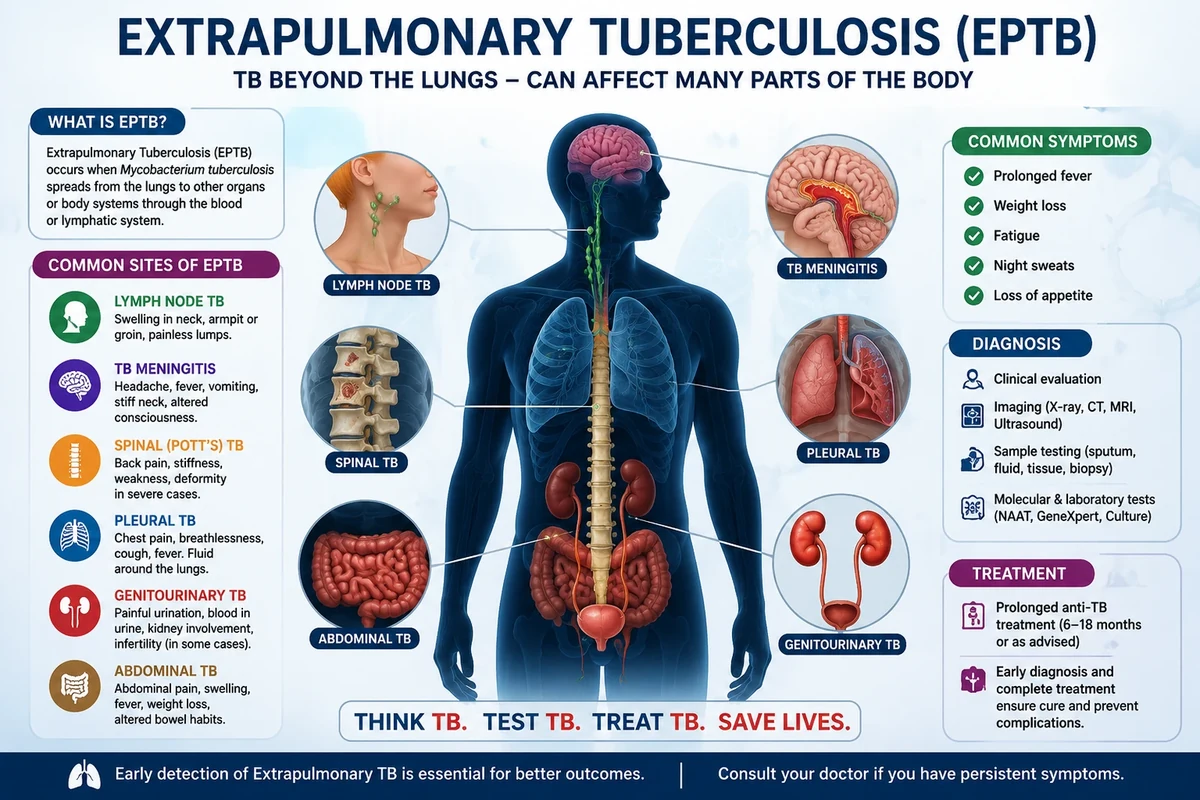
Question 5What symptoms can extrapulmonary TB cause?
Symptoms depend entirely on the organ affected:
●Lymph node TB
A painless swelling in the neck, armpit or groin — often the first and only sign.
●TB meningitis
Headache, vomiting, confusion or neck stiffness. This form needs urgent assessment.
●Spinal / bone TB (Pott's spine)
Persistent back pain, spinal deformity, or weakness of the limbs.
●Pleural TB
Chest pain and breathlessness from fluid collecting around the lungs.
●Genitourinary TB
Painful urination, blood in the urine, kidney involvement, and infertility in some cases.
●Abdominal TB
Abdominal pain, swelling, altered bowel habits, fever or weight loss.
Question 6Is extrapulmonary TB contagious?
Extrapulmonary TB alone is generally less likely to spread to others, because the bacteria are not usually being released from the lungs.
However, a patient may also have undiagnosed pulmonary TB at the same time — so appropriate evaluation of the chest is important in every EPTB case.
Question 7How is TB diagnosed?
Evaluation may include chest imaging, sputum testing and rapid molecular tests. For extrapulmonary TB, samples such as lymph-node tissue, pleural fluid, cerebrospinal fluid, pus or other affected tissue may be required.
- Imaging — X-ray, ultrasound, CT or MRI, depending on the site.
- Sample testing — sputum, fluid, tissue or biopsy from the affected organ.
- Rapid molecular tests — NAAT and GeneXpert, which detect TB and rifampicin resistance within hours.
- Culture — confirms the organism and full drug-sensitivity pattern.
The World Health Organization recommends using rapid diagnostic testing wherever possible, rather than relying on clinical suspicion alone.
Question 8Can tuberculosis be completely cured?
Yes. Most drug-sensitive TB can be cured with a properly selected combination of anti-tuberculosis medicines. Treatment must be taken regularly, for the full prescribed duration.
Stopping medicines early — even when you start feeling better — can cause relapse, treatment failure and drug-resistant TB (MDR-TB), which is far harder and far longer to treat. Complete the course exactly as prescribed.
Question 9When should you see a TB specialist?
Consult an experienced infectious-diseases physician for persistent symptoms, complicated TB, suspected extrapulmonary disease, drug-resistant TB, TB with diabetes or HIV, or if treatment is not producing the expected improvement. Accurate diagnosis and a correctly planned regimen make the difference between cure and relapse.
Sources
- World Health Organization — Tuberculosis fact sheet
- World Health Organization — Tuberculosis: questions and answers
- Centers for Disease Control and Prevention — TB clinical signs and symptoms
- Centers for Disease Control and Prevention — TB clinical overview
Consult a TB specialist in Indore
For persistent cough or fever, suspected extrapulmonary TB, drug-resistant TB, or treatment that is not improving, consult Dr. Ankesh Gupta — Consultant in Infectious Diseases at Choithram Hospital, Indore, and Madhya Pradesh's first DM-qualified Infectious Diseases specialist. Accurate diagnosis, rapid molecular testing and a correctly planned regimen give the best chance of complete cure.