
Rabies prevention is an emergency after a significant exposure
Wash every bite or scratch immediately with soap and running water for at least 15 minutes and obtain prompt medical assessment. Do not wait for the animal to become ill before seeking advice.
☎ Call: +91 81304 49731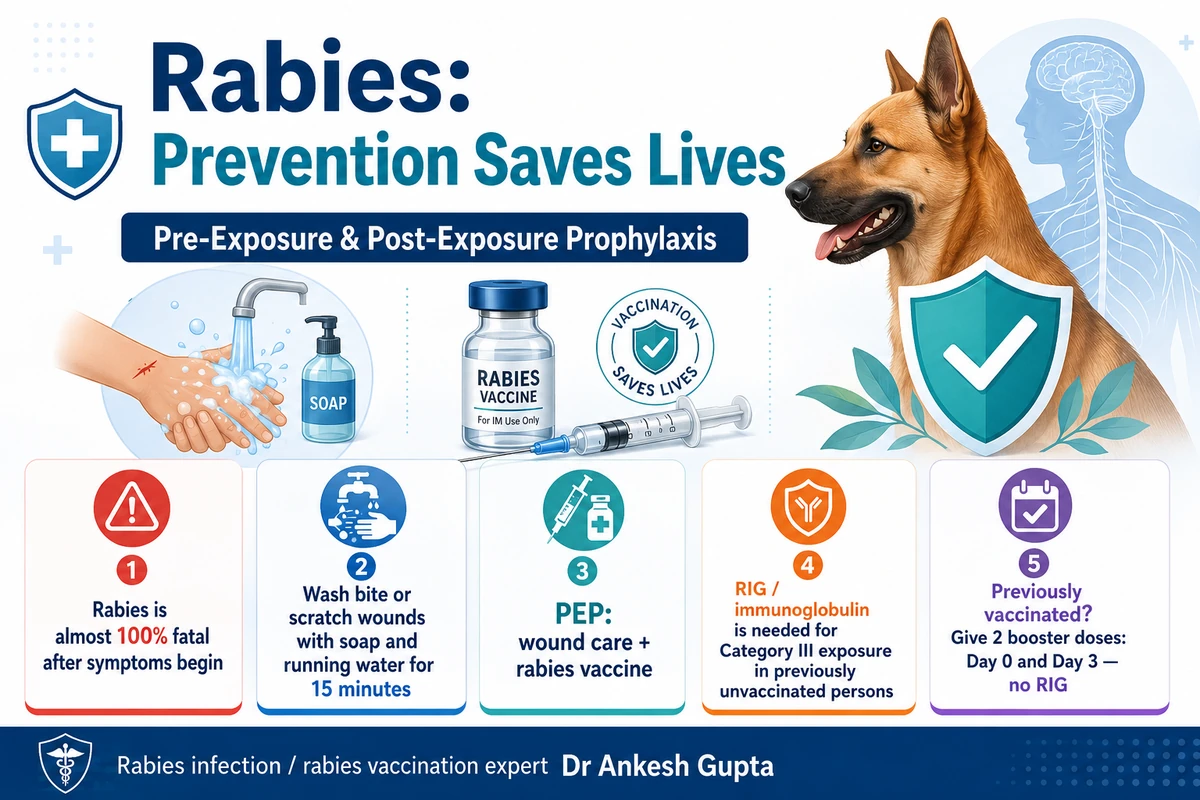
Question 1What is rabies and how does it spread?
Rabies is a severe viral infection of the brain and nervous system caused by the rabies virus. It is usually transmitted through the saliva of an infected animal, most commonly following a dog bite or scratch. Infection can also occur when infected saliva comes into contact with broken skin, the eyes, mouth or another mucous membrane.
Because India remains a rabies-endemic country, anyone requiring dog bite treatment, anti-rabies vaccine or rabies vaccination in Indore should seek medical assessment as early as possible. A rabies infection expert such as Dr Ankesh Gupta can assess the type of exposure and determine whether vaccination and rabies immunoglobulin are required.
Question 2Why is rabies considered almost 100% fatal?
Rabies is one of the most dangerous infectious diseases because it is almost completely preventable after exposure when appropriate treatment is given, but is nearly 100% fatal once clinical symptoms develop.
After entering through a bite or scratch, the virus travels through peripheral nerves toward the spinal cord and brain. Early symptoms may include fever, pain or abnormal sensations around the bite site. Later, patients may develop agitation, difficulty swallowing, hydrophobia, aerophobia, confusion, paralysis, coma and death.
Do not wait for symptoms
Rabies post-exposure prophylaxis (rabies PEP) must be started before neurological symptoms develop. Once symptomatic rabies begins, vaccination cannot reliably prevent the disease.
Question 3What should be done immediately after a dog or animal bite?
Correct wound care is the first step in rabies prevention. The wound should be washed thoroughly with soap and running water for at least 15 minutes. A suitable virucidal antiseptic such as povidone-iodine may then be applied.
Do not apply chilli, turmeric, soil, lime or other traditional substances to the wound. Medical assessment should not be delayed simply because the bite appears small. Patients seeking dog bite treatment in Indore or an animal bite specialist in Indore should ideally be evaluated promptly.
Question 4Which animal exposures need the anti-rabies vaccine?
Rabies exposures are commonly divided into three categories:
Question 5What is rabies Post-Exposure Prophylaxis (PEP)?
Rabies PEP is emergency preventive treatment given after a possible rabies exposure. It consists of immediate wound washing, a complete course of rabies vaccination and rabies immunoglobulin when indicated.
For a person who has never previously received rabies vaccination, a commonly used intramuscular schedule includes vaccine on days 0, 3, 7 and 14. Immunocompromised individuals may require an additional dose on day 28 and assessment of the immune response according to the chosen guideline and clinical setting.
WHO-recommended intradermal rabies-vaccine schedules are also used at trained centres. The correct schedule depends on the vaccine route, prior vaccination history and local programme recommendations.
Question 6When is rabies immunoglobulin or RIG required?
Rabies immunoglobulin (RIG) provides immediate passive antibodies until the patient's own immune response develops after vaccination. It is generally indicated in a previously unvaccinated person with a Category III exposure.
Whenever anatomically possible, human rabies immunoglobulin or another recommended rabies antibody product should be infiltrated thoroughly into and around the wound. It should not be injected in the same syringe or at the same anatomical site as the first vaccine dose.
Timing matters: RIG is ideally given when PEP is started. If it was not available on day 0, it can generally be administered up to and including day 7 after the first rabies vaccine dose. After day 7, it is usually not recommended because vaccine-induced antibodies are expected to be developing.
A rabies vaccination expert Dr Ankesh Gupta can help determine whether a RIG injection is required in situations such as multiple bites, deep wounds, facial bites, delayed presentation or uncertain previous vaccination history.
Question 7What if I have already received rabies vaccination in the past?
Previous vaccination changes the management considerably. Someone who has previously completed an accepted rabies pre-exposure prophylaxis or post-exposure prophylaxis course generally requires immediate and thorough wound washing and two rabies booster doses on days 0 and 3.
Rabies immunoglobulin should not be given to an adequately previously vaccinated person. Their immune system already has immunological memory and responds rapidly to booster vaccination.
Patients seeking a rabies booster after previous vaccination should tell the doctor when and which vaccine schedule they previously completed. If the previous course was incomplete, undocumented or involved a non-standard vaccine, individual assessment may be needed.
Question 8What is rabies Pre-Exposure Prophylaxis (PrEP)?
Rabies pre-exposure prophylaxis, or rabies PrEP, means vaccination given before a known animal exposure occurs. It may be appropriate for veterinarians, animal handlers, wildlife workers, rabies laboratory personnel, people with frequent occupational animal exposure and selected travellers to places where reliable PEP may be difficult to obtain.
A commonly recommended PrEP schedule consists of two doses on days 0 and 7. People with continuing high occupational exposure may sometimes require antibody monitoring or a booster according to their risk category.
Question 9Does PrEP mean no treatment is required after a future dog bite?
No. Pre-exposure vaccination provides an important advantage, but it does not mean that a later bite can be ignored.
After a significant future exposure, a previously vaccinated individual still requires wound cleaning and usually rabies vaccine booster doses on days 0 and 3. However, rabies immunoglobulin is not required, making post-exposure management considerably simpler.
Question 10Do dog lovers need rabies vaccination every few months?
No. Routine rabies boosters every few months are not recommended simply because someone owns dogs or frequently interacts with animals. The need for rabies PrEP, antibody testing or booster vaccination depends on the person's actual exposure risk and previous vaccination history.
Vaccinating household dogs, avoiding contact with unknown or sick animals, and seeking appropriate medical care after every significant exposure remain the most important preventive measures.
Question 11When should you urgently consult a doctor?
Seek medical attention promptly after a dog or other mammal bite that breaks the skin, scratches from a potentially rabid animal, saliva entering the eye or mouth, saliva contaminating an open wound, deep or multiple bites, bites to the face, head, neck, fingers or hands, bat exposure, exposure in young children, uncertain previous vaccination history or exposure in an immunocompromised person.
Rabies should never be managed according to the size of the wound alone. For rabies treatment in Indore, anti-rabies vaccination, dog bite vaccination, rabies PEP, rabies PrEP or assessment for human rabies immunoglobulin, consult rabies infection / rabies vaccination expert Dr Ankesh Gupta, Infectious Diseases Specialist in Indore.
Sources
- World Health Organization — Rabies fact sheet
- World Health Organization — Rabies post-exposure prophylaxis recommendations
- Centers for Disease Control and Prevention — Rabies post-exposure prophylaxis guidance
- Centers for Disease Control and Prevention — Rabies biologics and HRIG timing
- Centers for Disease Control and Prevention — Rabies pre-exposure prophylaxis guidance
Rabies vaccination and animal-bite assessment in Indore
For dog bite treatment, anti-rabies vaccination, rabies PEP, rabies PrEP, booster advice after previous vaccination or assessment for rabies immunoglobulin, consult rabies infection / rabies vaccination expert Dr Ankesh Gupta at Choithram Hospital, Indore.